The bandwidth question has a boring answer
A single call in each direction uses about 85 to 100 kbps with G.711, the codec most Jamaican business systems use because it sounds best and costs nothing in processing. With G.722 or Opus it is less.
Ten people on the phone at once is under 1 Mbps. Twenty is under 2 Mbps.
If you are on a business fibre plan, your phones are not the problem. We have never once told a customer in Kingston that they needed to buy more speed to make calls work.
The number that actually matters
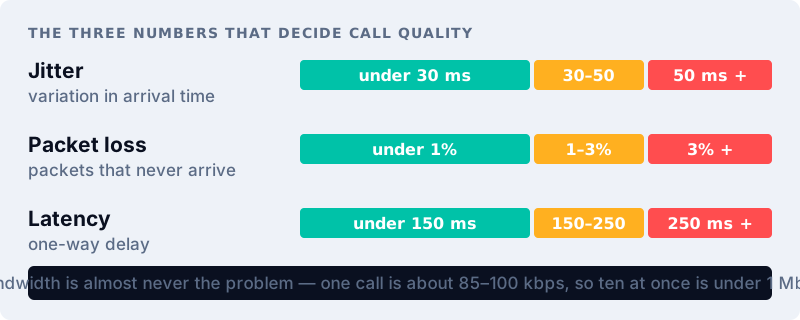
Three things decide whether a call sounds right, and none of them is the headline speed on your bill:
- Jitter — variation in how long packets take to arrive. Under 30 ms is comfortable. Above about 50 ms you start
hearing it as choppiness.
- Packet loss — packets that never turn up. Under 1% is fine; voice codecs conceal a little. At 3% people start
saying "you're breaking up".
- Latency — one-way delay. Under 150 ms feels like a normal conversation. Past about 250 ms people start talking
over each other, because the natural gap that tells you the other person has finished is gone.
A 500 Mbps line with 80 ms of jitter sounds worse than a 20 Mbps line with 5 ms. Speed tests measure the thing that is almost never wrong.
Where it usually does go wrong
In order of how often we find it:
- Wi-Fi. Most "the phones are bad" calls are Wi-Fi calls. A desk phone on a cable behaves; a softphone on office
Wi-Fi at the far end of a concrete building does not.
- A router doing too much. Consumer routers with SIP ALG switched on rewrite call signalling and break it. It is
one setting, and turning it off fixes calls that have been "mysterious" for months.
- No prioritisation. Someone uploads a large file and every call degrades at once. QoS on the router fixes it.
- The upstream, not the downstream. Jamaican plans are often advertised on download speed. Calls need upload,
and a plan with a thin upstream will struggle long before the download does.
Test before you buy, not after
You can measure your own line in about thirty seconds with the connection test on our home page. It runs in the browser and reports round-trip time, jitter and loss.
Before any install we run a fuller network readiness assessment on each site and give you the report — whether or not you end up buying from us. If your line cannot carry calls today, we would rather tell you that up front than sell you a phone system and argue about it afterwards.